Born Again

In the summer of 1976, as Chairman Mao lay on his deathbed in Beijing, the pigs at the Ximen Village Production Brigade Apricot Garden Pig Farm in Gaomi County, Shandong Province, also began to die. The first batch of five were found with “their skin dotted with purple splotches the size of bronze coins, their eyes open, as if they’d died with unresolved grievances.” The commune vet declared they had succumbed to “what we call the Red Death” and ordered them to be cremated and buried immediately. But it had been raining for weeks and the ground was too waterlogged. Dousing the carcasses with kerosene and trying to set them alight simply filled the farm with vile-smelling smoke. Soon 800 more pigs were infected. A fresh team of vets arrived by motorboat with more sophisticated medicines, but their ministrations were of little help. Dead pigs were piled up throughout the farm, their bloated forms expanding and exploding in the heat.
Unable to bury the corpses, the farmers “had no choice but to wait until the veterinarians left and, in the fading light of dusk, load the carcasses onto a flatbed wagon and haul them down to the river, where they were tossed into the water to float downstream — out of sight and out of mind.” The farm was in ruins, proof that its “glorious days” were “now a thing of the past.” The foundations of the hog houses collapsed, and raging flood waters toppled the utility poles, cutting the commune off from the wider world. Thus it was only through the village’s single transistor radio that these farmers learned Mao had died. “How could Chairman Mao be dead? Doesn’t everyone say that he could live at least 158 years?”
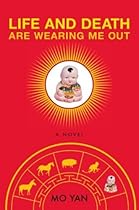
Mo Yan’s powerful new novel,
“Life and Death Are Wearing Me Out,” contains many such vivid set pieces. His canvas covers almost the entire span of his country’s revolutionary experience — from 1950 until 2000, in the so-called “reform era” of post-
Deng Xiaoping China. At one level, therefore,
“Life and Death” is a kind of documentary, carrying the reader across time from the land reform at the end of the Chinese Civil War, through the establishment of mutual-aid teams and lower-level cooperatives in the early and mid-1950s, into the extreme years of the Great Leap Forward and the famine of the late ’50s and early ’60s, and on to the steady erosion of the collective economy in the new era of largely unregulated “capitalism with socialist characteristics.” At the novel’s close, some of the characters are driving BMWs, while others are dyeing their hair blond and wearing gold rings in their noses.
Yet although one can say that the political dramas narrated by
Mo Yan are historically faithful to the currently known record,
“Life and Death” remains a wildly visionary and creative novel, constantly mocking and rearranging itself and jolting the reader with its own internal commentary. This is politics as pathology. From the start, the reader must be willing to share with Mo Yan the novel’s central conceit: that the five main narrators are not humans but animals, albeit ones who speak with sharply modulated human voices. Each of the successive narrators — a donkey, an ox, a pig, a dog, a monkey — are the sequential reincarnations of a man named
Ximen Nao, as determined by Yama, lord of the underworld.
Ximen Nao, a 30-year-old wealthy landlord in Gaomi County, is shot on a cold December day at point-blank range by one of his fellow villagers in the first period of land reform after the Communist takeover. Confident that his life on earth has been honest, constructive and valuable to the community, that he has been a good son and devoted father, a loving spouse to a principal wife and two concubines, Ximen Nao protests against the injustice of his fate. Yama responds by observing that it is well known that many people “who deserve to die somehow live on while those who deserve to live die off.” Therefore, Yama agrees to grant a transmigration for Ximen Nao, and it is from that moment that he returns to earth, first in animal and finally again in human form.
Such a fictional procedure is, of course, fraught with difficulties of tone and narration. The five different animal narrators must describe their own experiences in their own animal voices, tinged with some of the emotions and knowledge of their previous lives on earth. Their main anchor to what we might call reality lies in the fact that each has some connection to Ximen Nao’s surviving hired hand, Lan Lian, a tough, dour, hard-working farmer who insists on clinging to his own small plot of family land and adamantly refuses to join any of the successive socialist organizations. Willful, proud and enduring, Lan Lian is the owner or companion of each of the animals in turn. They share their scanty rations and labor together. Though they cannot talk to one another, Lan Lian somehow senses in each of these five beings some joint and nostalgic memory of his own murdered landlord.
Such a brief summary may make the book sound too cute when it is, in fact, harsh and gritty, raunchy and funny. The revolutionaries’ village politics are deadly; sex in the village (whether human or animal) is flamboyant and consuming. Death is unexpected and usually violent. Coincidences of plotting abound. The zaniest events are depicted with deadpan care, and their pathos is caught at countless moments by the fluent and elegant renderings of the veteran translator Howard Goldblatt. One might have thought it impossible, but each animal does comment with its own distinctive voice — the mordant view of the multiple deaths on the pig farm, for instance, comes largely from the reincarnated pig persona. In addition, either Lan Lian or some other human will often pick up the burden of narration and commentary.
The book’s author is also frequently in evidence within the narrative structures. His limitations as a writer and a person are consistently mocked, and we are regularly reminded by
Mo Yan the author that the character of Mo Yan represented in the novel is not to be trusted. “Mo Yan was never much of a farmer,” we are told. “His body may have been on the farm, but his mind was in the city. Lowborn, he dreamed of becoming rich and famous; ugly as sin, he sought the company of pretty girls; generally ill-informed, he passed himself off as a knowledgeable academic. And with all that, he managed to establish himself as a writer, someone who dined on tasty pot stickers in Beijing every day.” By the end of the novel,
Mo Yan has developed a separate existence as one of the main characters. It is at his home in the city of Xi’an that Lan Lian’s son is able to take shelter with his lover for five difficult years.
Mo Yan even makes sure that the couple have a supply of Japanese condoms.
“Life and Death Are Wearing Me Out” is not unremittingly hostile to the Communist system, and at times
Mo Yan seems eager to rebuild the very bridges he has been burning. “I have nothing against the Communist Party,” Lan Lian says at one despairing stage, “and I definitely have nothing against Chairman Mao. I’m not opposed to the People’s Commune or to collectivization. I just want to be left alone to work for myself.” But such reassurances of party loyalty seem frail in the context of such a vast, cruel and complex story.
The kind of critique that we find in this book has many echoes within China today. In his new novel,
“Wolf Totem,” Jiang Rong includes a ferocious account of the battle between a starving wolf pack and a herd of wild horses that seems tightly geared to showing the value of older ways of living in the steppe, in contrast with the ultimately disastrous values insisted on by the Party.
Mo Yan has his own version of such a battle in his account of the donkeys’ struggle against the wolves near the collective farm. Yan Lianke’s “Serve the People!” gives a common soldier and his mistress, the wife of the division commander, a summer of passionate lovemaking, culminating in a wild and randy spree in which they smash all the once-treasured artifacts and memorabilia of
Mao Zedong and his outmoded, pointless policies. Such antipolitical passion also surfaces in many of the sexual entanglements
Mo Yan describes in
“Life and Death Are Wearing Me Out.” It seems that novels in China are coming into their own, that new freedoms of expression are being claimed by their authors. Mao has become a handy villain. One wonders how much longer his successors will be immune from similar treatment.
From: The New York Times: By JONATHAN SPENCE: May 4, 2008
Jonathan Spence teaches modern Chinese history at Yale. His latest book is “Return to Dragon Mountain: Memories of a Late Ming man.”